A Blog About Understanding The Toyota Production System and Gaining Its Full Benefits, brought to you by "The Toast Guy"
In my last post, I reflected on a couple different whys to interrogate a process – either to solve a problem or to create a process improvement. Here are a few more contextual uses of the question “Why?” that I’ve found very helpful as a manager and improvement leader:
Purpose expansion.
When asking why 5 times to solve a specific problem, we are intentionally drilling down into the problem to find a root cause. Shigeo Shingo flipped the scale with purpose expansion to encourage us to think of every end as a means to a higher purpose. For example, if 5S is a means to a higher purpose (reduced searching for tools) , then reduced searching (motion waste) must also be a means to a higher purpose:
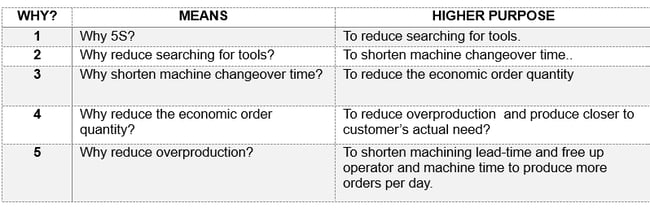
Swapping means and ends, Shingo said, created clarity for each of the successive means as a component of the Toyota Production System. The significant human component is that people are not motivated by "Just do this to get that." A higher purpose is necessary to respect human nature.
Why not?
From Deming Prize Winner, Ryuji Fukuda, comes the question “Why not?”, a change management device based on the idea that it’s easier to articulate why a change can NOT be made. For example, I once posed the question to our field sales force, “Why not double sales?” Using Post-It notes, sales persons were asked to record ideas in silence, one fact per note. Card writing was furious:
Price too high. Lead-time too long. Defective products. Product life concerns. Apologizing to customers taking time that could have been used for selling.
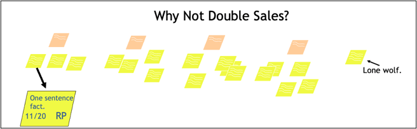 The very nature of question, stated in the negative generated an emotional response, a collective mind dump of frustrations. As the excitement died down, all of the why nots were organized by similarity in an affinity diagram. Together, we’d chunked the big problem into a series of shared concerns and even discovered a couple totally new ideas (lone wolves.) My next question to the group was “So, if we address each of these issues, then we can double sales?” It was like linguistic judo, giving everyone a chance for input and turning individual complaints into a shared understanding of the current condition
Why not half?
This specific use of why-not is directed to breaking down and reducing one or more of the 7 wastes. I learned from it Hiroyuki Hirano. The question could be applied to any of the 7 wastes. Why not half as much motion? Or half as much inventory? And so on. The intent of the question was to look more granularly into contributing factors. For example, if a machine set-up took 90 minutes, then why not 45? Operators could trace the set-up steps in a linear way. How much time to gather materials? How much time to set tools? How much time for adjustments. Because each improvement reduced operators hassles, the arbitrary 50% target was often exceeded. And once a goal was achieved, the next question would be “Ok, why not half again?”
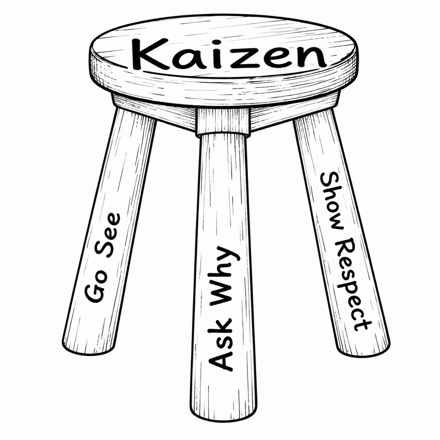
Go see. Ask why. Show respect.
From my friend and mentor, John Shook, comes a quote he heard directly from Fujio Cho during the establishment of TSSC. I think Mr. Cho’s perspective is especially important because of the radical shift it proposed in traditional management behaviors: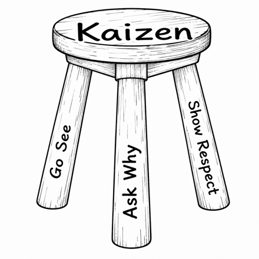
- Go See. Get out of the board room and go to the Gemba. Don’t delegate this key management role to kick start the improvement engine.
- Ask why. Much like Shigeo Shingo’s 5W1H analysis, break down the process to make the job easier. For example, why here, why now, why this way, why this many, why this method? Don’t be the keeper of the status quo
- Show respect. Be humble. Go to see and learn from the experts, the people who are doing the job. They’ll have a lot to share if you are able to actually listen.
Like three legs of a stool, these three principles together describe a system where Kaizen means continuous process improvement powered by a visible management commitment and continuous human development. Take away one leg, and the system fails.
Which of these why’s do you use? Have I missed any. Please share an idea.
O.L.D. PS Just a couple weeks until our 22nd Annual Northeast Lean Conference. Want to learn how industry leaders from manufacturing, healthcare and service are integrating AI in the “How” of continuous improvement? Please join us on September 28-29 in Springfield, Massachusetts. More information here.