A Blog About Understanding The Toyota Production System and Gaining Its Full Benefits, brought to you by "The Toast Guy"
With Labor Day just a little over a week away, here’s a post about work and workers:
Last week a Lean colleague shared with me an article from Fortune magazine which argues that the traditional daily commute may largely disappear by 2040 as work becomes separated from a company’s central office. Mark Dixon, CEO of flexible-workspace provider IWG, predicts in this article that future generations will find it irrational that employees once traveled long distances merely to access a computer.
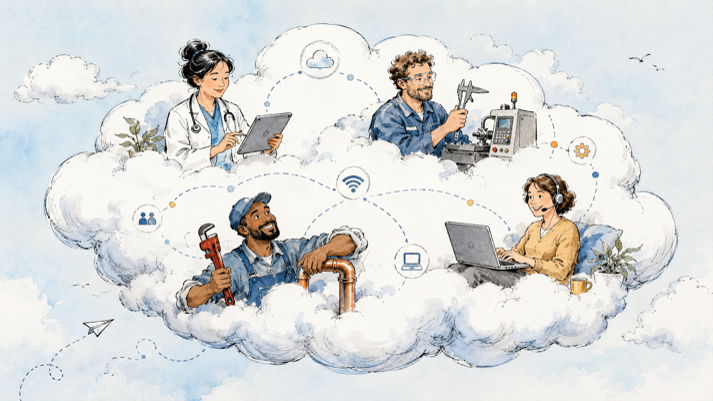
 My three adult children are already living this dream. Untethered to offices, they can do their work from anywhere and pretty much on their own time. However, the cascading implications of this shift are endless and were predicted forty years ago by Stan Davis in his groundbreaking classic, Future Perfect. Davis anticipated in 1987 that emerging information technologies would change the economic meaning of time, space and matter. His concept of “anywhere” anticipated a world in which work would no longer be confined to a particular office, factory or even country.
That future has arrived, although perhaps not exactly as Stan Davis imagined. Cloud computing, smartphones, videoconferencing and artificial intelligence have separated many kinds of work from a fixed workplace. A marketing specialist can work from home, a software developer can collaborate with colleagues across several continents, and a physician can advise a patient hundreds of miles away. And with the addition of agentic robotics even face-to-face work and skilled a labor are becoming anywhere work. Increasingly, work is something people -- or machines -- do rather than a place to which they travel.
The optimistic view is compelling. Anywhere work gives people greater control over their lives. It eliminates hours of commuting, expands employment opportunities for people with disabilities and allows old lean dudes like me to remain in the workforce. Employers can recruit talent based on ability rather than proximity. Small and remote communities can participate in economic activity once concentrated in major cities. Artificial intelligence amplifies these possibilities, providing access to capabilities that previously required large organizations or specialized departments. A small business like GBMP can use AI for research, translation, design, data analysis and customer support. Someone with a good idea can accomplish more with fewer resources. From this perspective, technology does not replace people; it extends our reach. Google DeepMind’s Demis Hassabis argues that organizations should use AI productivity gains to accomplish more, rather than simply employ fewer people. This optimistic future of anywhere work is therefore one of expanding human capability. People are freed from repetitive tasks, unnecessary travel and geographic limitations. Work becomes more flexible, inclusive and productive.
Yet I can’t help feeling a little uneasy about anywhere work.
When work can be done anywhere, it can also be moved anywhere. The employee liberated from the office may now compete with workers around the world. The same technology that allows someone to work remotely from Massachusetts allows the employer to assign that work to a lower-cost location or to an AI agent that has no location at all. This is not hypothetical. I see it today at customers large and small: tactical choices are made to reduce cost by replacing people with technology. For example, Amazon founder Jeff Bezos has optimistically compared AI to giving a bulldozer to someone digging with a shovel. The worker is not made obsolete, but elevated to more ambitious work. Bezos predicts that AI-driven productivity will stimulate so much demand that it will create labor shortages. Yet at the same time, Amazon CEO Andy Jassy has told employees that greater use of AI and agents is expected to reduce the company’s corporate workforce in the next several years. Since October of 2025 Amazon has cut 30,000 jobs. Who do I believe?
Could “anywhere work” could eventually become “work without people”? According to Elon Musk, that answer is yes. Robotics could gradually remove the remaining geographic protection surrounding physical work. A plumber cannot currently repair a sink from another country, nor can a nursing assistant help a patient out of bed through a computer screen. But increasingly agentic robots could bring remote intelligence into the physical workplace. The robot may be local while its programming, supervision and economic ownership reside elsewhere. Elon Musk carries this argument to its furthest conclusion. He predicts that AI and robotics will eventually make most employment optional. Machines will produce unprecedented abundance, and society will provide people with a universal high income. That is an optimistic destination, but it leaves unanswered questions about the transition: Who owns the machines? Who receives the gains? Where do people find purpose, dignity and social connection if paid work disappears? In an April 2026 post on X, Musk predicted that all work will eventually be performed by AI and Robotics, proclaiming that “Universal HIGH INCOME via checks issued by the Federal government is the best way to deal with unemployment caused by AI.” What does this imply about government involvement?
Of the tech giants, only Microsoft’s Bill Gates seems publicly concerned, arguing in Gates Notes last week that comparisons to earlier technological revolutions may be misleading. Previous technologies replaced physical effort while creating new jobs requiring human thought. AI can substitute for human cognition itself. It can perform tasks in law, medicine, customer service, software and manufacturing and it can spread much faster than earlier technologies.
This reveals the central tension in anywhere work. Technology can free work from place, but it can also free organizations from dependence on particular people. As Bill Gates notes, the outcome is not predetermined. It depends upon choices made by leaders, workers and society. Will productivity gains be used primarily to reduce headcount, or to shorten hours, improve service and create new value? Will AI eliminate entry-level positions, or help inexperienced employees learn faster? Will people participate in redesigning their work, or simply have technology imposed upon them?
For Lean thinkers, the distinction is critical. The future of anywhere work is not fundamentally about where work occurs. It is about who - or what - will perform it, who will benefit from it and whether people will retain a meaningful place within it. AI may make work possible anywhere. Our larger responsibility is to ensure that the future of work still includes people.
Paraphrasing my esteemed teacher, Hajime Ohba, the ideal condition for Anywhere Work is not about what we CAN do. It’s about what we SHOULD do.
Are you an optimist, a pessimist or a little of both. Please share a thought. And have a happy Labor Day.
O.L.D.
 There's just one month until our 22nd Annual Northeast Lean Conference. Want to learn how industry leaders from manufacturing, healthcare and service are integrating AI in the “How” of continuous improvement? Please join us on September 28-29 in Springfield, Massachusetts. Click for more information.