Lean Workshops vs. Consulting Engagements: Which Is Right for You?
When an organization decides to invest in lean, one of the first decisions is how to get there: through structured training or hands-on consulting...
2 min read
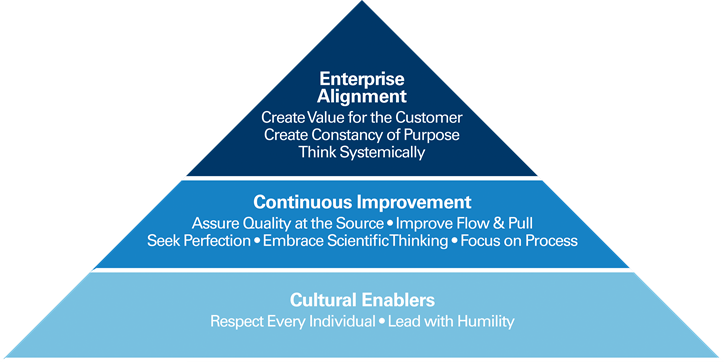
Most continuous improvement efforts stall because they focus on tools instead of culture. A team runs a kaizen event, improves a process, and then slowly watches the gains erode as old habits return. The Shingo Model was developed to solve exactly that problem. Built around principles rather than prescriptive methods, the Shingo Model gives organizations a comprehensive framework for achieving and sustaining operational excellence at every level - from the shop floor to the executive suite. Understanding the model is the first step toward building an improvement culture that actually lasts.
The Shingo Model was developed by the Shingo Institute at Utah State University and named after Japanese industrial engineer Shigeo Shingo, whose work influenced the Toyota Production System. The Shingo Institute distilled decades of operational excellence research into a tiered model built on guiding principles organized across four dimensions: cultural enablers, continuous improvement, enterprise alignment, and results. Unlike certification programs tied to a single methodology, the Shingo model acknowledges that tools and systems are only as effective as the principles and behaviors driving them. When people understand the why behind improvement work, sustainable results follow.
At the top of the model sits the Shingo Prize, widely regarded as the most rigorous recognition for organizational excellence in the world. Earning the Shingo Prize requires demonstrating that ideal behaviors are not just practiced by leadership but embedded throughout the entire organization, a distinction that separates it from most performance awards.
 Shingo Institute training is structured as a progression of workshops, each designed to build deeper understanding of the model's principles and their application.
The Discover Excellence workshop serves as the entry point, introducing the Shingo Model's foundational principles and helping participants see the gap between tool-focused improvement and principle-based transformation. It is typically recommended for all levels of leadership.
The Systems Design workshop is taken right after Discover Excellence and shifts focus to the Systems and Tools dimension of the Shingo Model. It teaches that every result an organization produces is the output of a system, and that systems left undesigned will evolve on their own. Participants learn the three essential types of systems, the communication tools needed to support each one, and how to build system maps and standard work that consistently drive ideal behavior.
The Continuous Improvement, Cultural Enablers and Enterprise Alignment workshops address the leadership disciplines required to create an environment where ideal behaviors emerge consistently at all levels, not just when a supervisor is watching. Each advances participants through increasingly sophisticated applications of the model. while connecting principles to the practical systems and behaviors organizations must develop to drive and sustain improvement.
Shingo Prize assessment workshops support organizations actively pursuing Shingo Prize recognition by teaching teams how to assess their current culture against the model's standards and identify meaningful gaps.
Shingo Institute training is experiential and discussion-based, designed to challenge assumptions and shift perspective rather than simply transfer information.
The Shingo Model doesn't replace lean, Six Sigma, or other improvement methodologies. It provides the principled foundation that makes those tools work long-term. Organizations that build their improvement culture on the Shingo model consistently report stronger engagement, more durable results, and a leadership team aligned around a common vision of excellence.
Shingo Model training is most powerful when led by those who truly understand the model. Learn about our Shingo workshop Master Trainers and discover how GBMP can help your organization apply the Shingo model to build a culture where operational excellence becomes the standard, not the exception.
When an organization decides to invest in lean, one of the first decisions is how to get there: through structured training or hands-on consulting...

If your production line keeps falling short of targets, the problem might be invisible losses hiding inside your equipment. OEE (Overall Equipment...
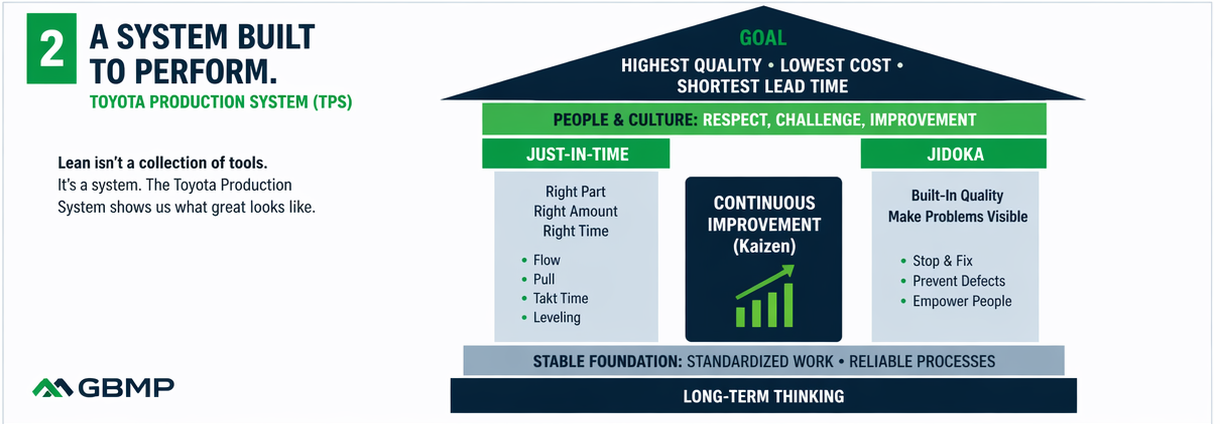
Lean manufacturing is a method for improving operations by eliminating waste and focusing only on activities that create value for the customer. At...