How to Build a Lean Training Program for Your Manufacturing Workforce
Building a lean training program for your manufacturing workforce is one of the most effective investments you can make in long-term operational...
2 min read
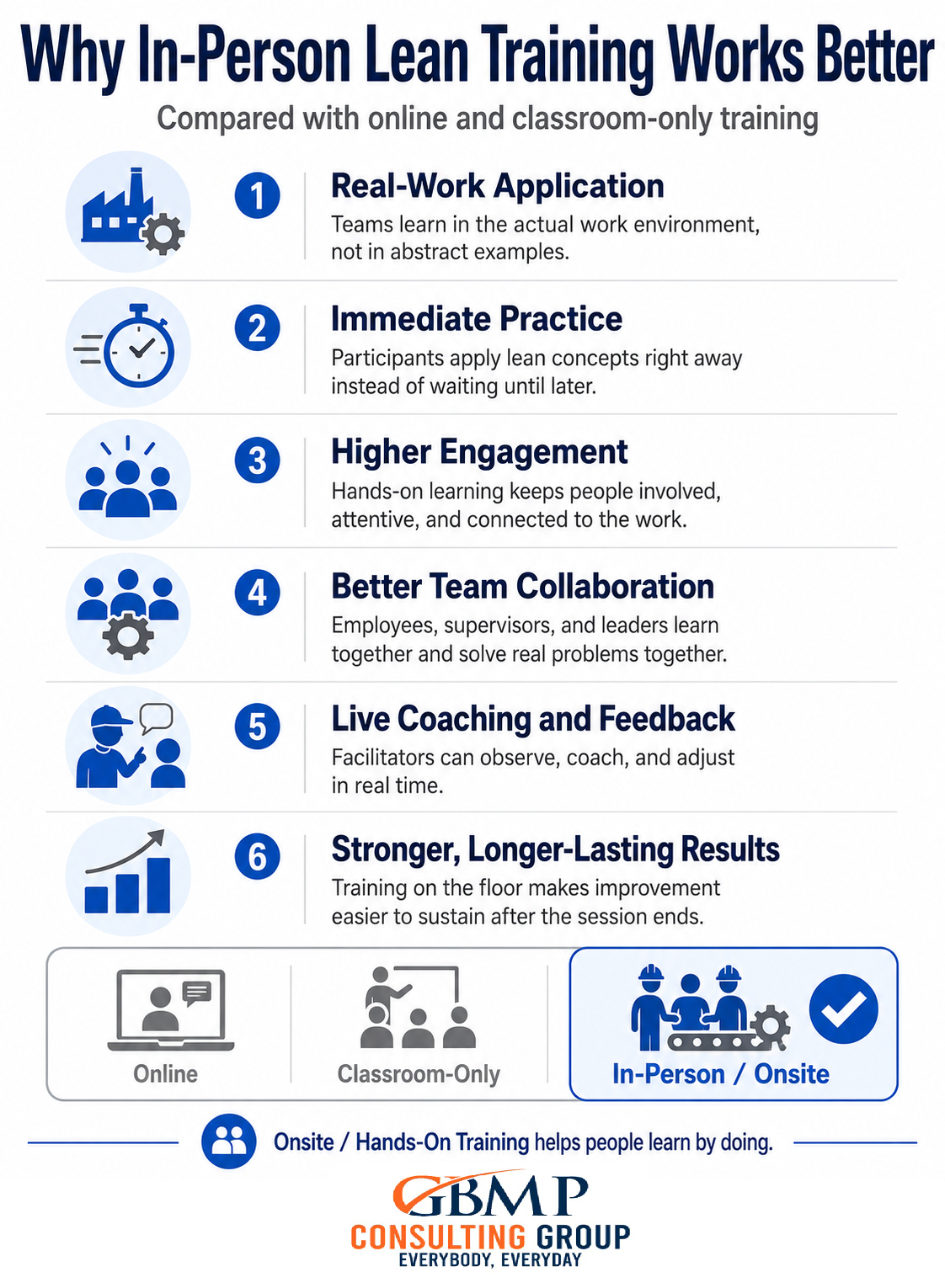
There is no arguing that lean training is most effective when people can connect what they are learning directly to the work they do every day. While classroom learning has an important place in familiarizing team members with the principles of continuous improvement and lean manufacturing (often called "the why"), it often falls short when teams are expected to apply concepts and countermeasures ("the how") to complex, fast-moving work environments. That is why in=person, onsite, hands-on, tacit lean training is so valuable for organizations that want practical, sustainable improvement.
Classroom-only training can introduce lean concepts such as waste reduction, flow, standard work, visual management, and problem solving. But real understanding and learning takes place when employees can see those ideas in action. When training moves from the classroom to the workplace, teams can observe actual conditions, identify real barriers, and practice improvement methods using their own processes.
GBMP’s approach to lean training emphasizes learning by doing. Instead of treating lean as a set of abstract tools, onsite training helps employees, supervisors, managers, and leaders understand how lean thinking applies to their specific environment. This makes the learning more relevant, more engaging, and easier to sustain.
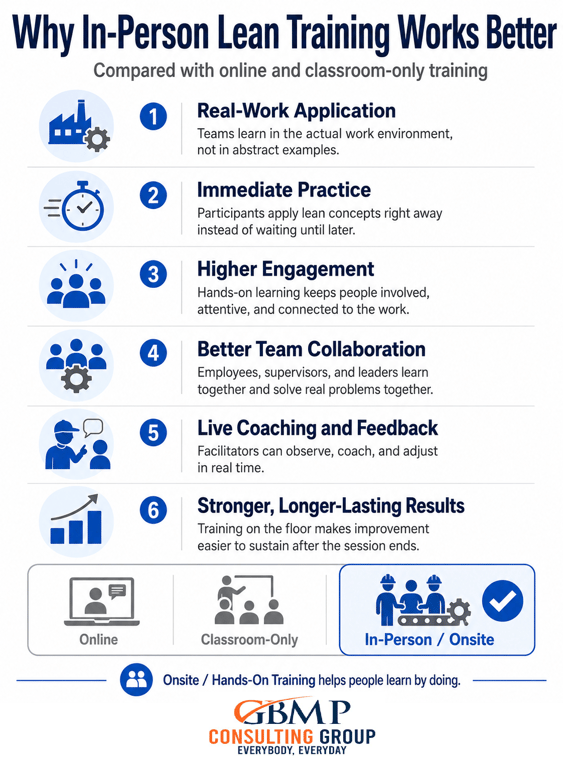
Lean training on the floor (whether the floor is a factory production, insurance company claims department, healthcare settings and more) allows participants to work with real examples they see everyday instead of hypothetical scenarios. Teams can walk the process, observe work as it happens, talk with employees, identify waste, and test improvements in the actual workplace. This creates a stronger connection between training and results.
Hands-on learning also helps build confidence. Employees are more likely to use new skills when they have practiced them in a familiar setting with guidance from an experienced facilitator. Rather than leaving a training session wondering how to apply what they learned, participants begin applying lean principles during the training itself and continue using them after the consultant has left.
Onsite lean training also supports stronger employee engagement, a key tenet of Lean and the Toyota Production System. When people are involved in improving their own work, they are more likely to understand the purpose of lean and contribute ideas. This helps shift lean from something being “rolled out” by leadership to something employees actively participate in and own. This is the goal: a problem-solving culture where employees feel empowered to speak up without fear of repercussion.
For leaders, onsite training provides a clearer view of the current condition. Managers and supervisors can see how daily management, communication, standard work, and problem-solving routines function in real time. Most importantly, leaders understand how critical their own actions and behaviors are to the outcomes and success of a lean implementation. This creates opportunities for coaching, alignment, and better support for frontline teams.
But, lean training facilitation is not one-size-fits-all. Different organizations need different types of training depending on their goals, experience level, and current challenges. Some teams may need an introduction to lean principles. Others may need deeper support with value stream mapping, kaizen facilitation, problem solving, daily management, standard work, or leadership development.
Yes, classroom training can be useful for building a shared language and foundational understanding. However, learning becomes much more powerful when paired with hands-on application. A blended approach allows participants to learn the concepts, experiment with them in practice, apply them to real work, see the results first-hand and reflect on what they learned.
Facilitated improvement activities are another important form of training. These sessions help teams focus on a specific process or problem while developing the skills to continue improving after the event is complete. Train-the-trainer and internal facilitator development can also help organizations build long-term capability.
Ultimately, the goal of lean training is not simply to complete a class. The goal is to help people improve how their work is done every day. Onsite, hands-on training creates the conditions for deeper learning, stronger participation, and more sustainable results.
To learn more about how GBMP can support your organization, visit our Training and Facilitation webpage or schedule a call with us. We would welcome the opportunity to learn about your goals, answer your questions, and explore the best approach for your team.
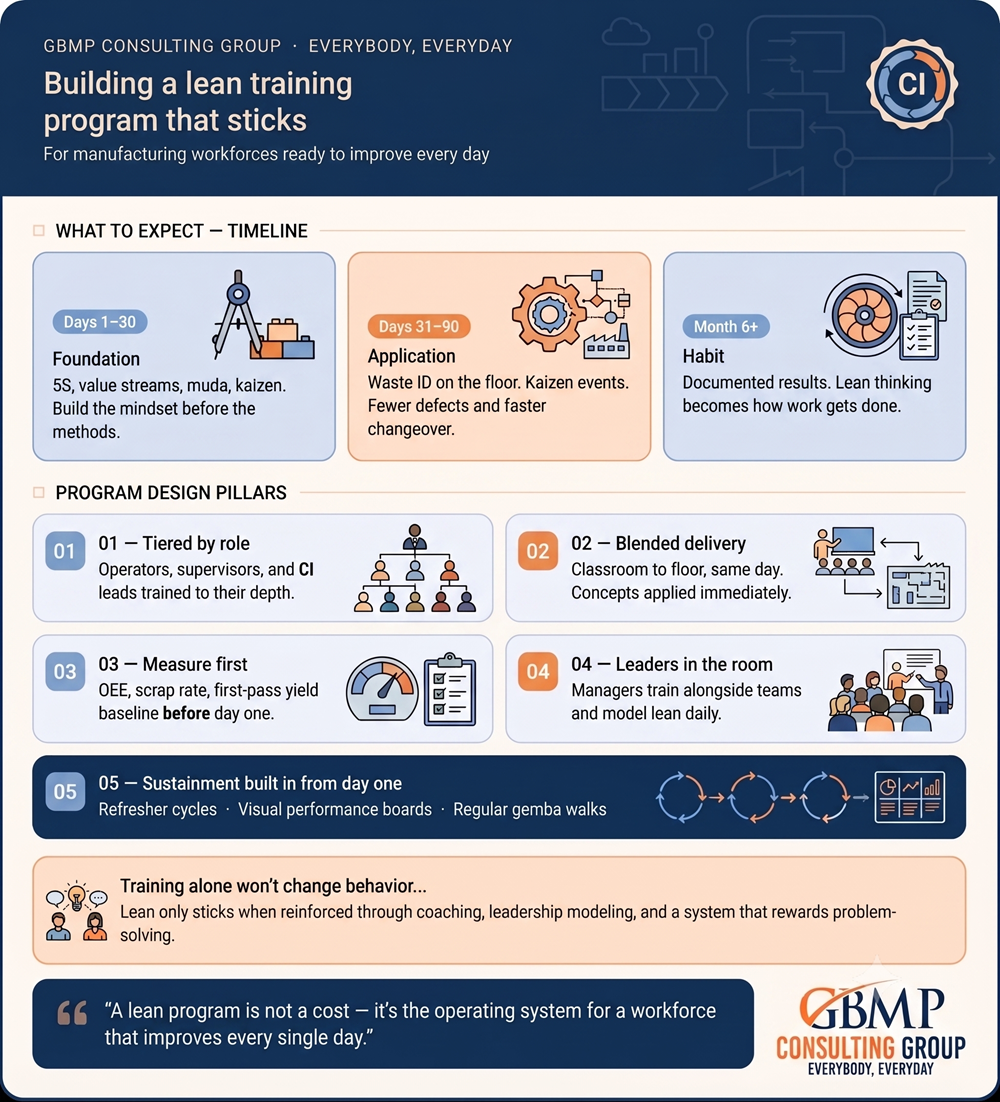
Building a lean training program for your manufacturing workforce is one of the most effective investments you can make in long-term operational...
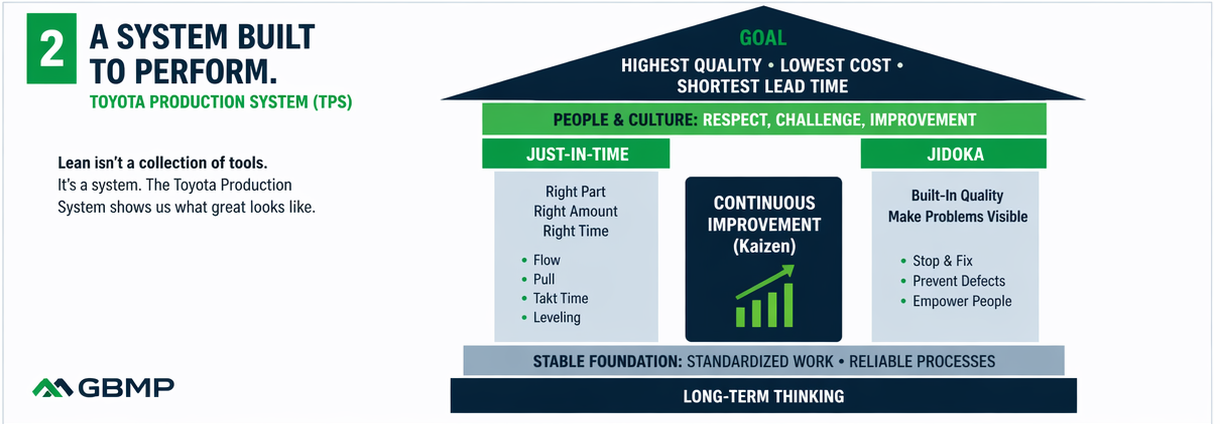
Lean manufacturing is a method for improving operations by eliminating waste and focusing only on activities that create value for the customer. At...

Uneven demand is one of the biggest causes of waste in manufacturing. When production swings from rush periods to idle time, teams often respond with...