What Is SMED? How to Reduce Changeover Time on the Shop Floor
Every minute your line is stopped for a changeover is a minute it isn't producing. In competitive manufacturing environments, that lost time adds up...
2 min read

If you've ever watched an assembly line run at a perfectly steady rhythm with no rushing and no waiting , then you've seen takt time in action. It's one of the most foundational concepts in lean manufacturing, and understanding it can transform the way you think about production flow.
Takt time is the maximum amount of time allowed to produce one unit of a product in order to meet customer demand. The word takt comes from the German word for "beat" or "pulse", and that's exactly what it is: the heartbeat of your production process.
It answers a simple but powerful question: How often does a customer need one unit?
If demand is high, your takt time is short. If demand is low, your takt time is longer. It's not about how fast your machines can run. It's about synchronizing your output to your customer's actual need.
The takt time formula is straightforward:
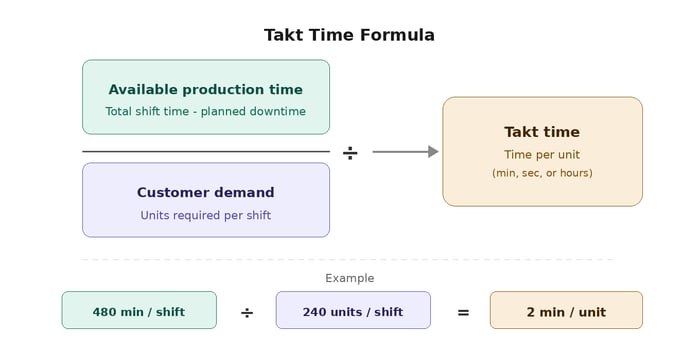
Takt Time = Available Production Time ÷ Customer Demand
For example, if your facility operates 480 minutes per shift and customers require 240 units per shift, your takt time is: 480 ÷ 240 = 2 minutes per unit.
That means one unit must be completed every 2 minutes to satisfy demand without overproducing or falling behind.
When calculating available production time, be sure to subtract planned downtime like breaks, meetings, and scheduled maintenance from total shift time. Accuracy is essential.
In lean production, waste is the enemy. Takt time is the tool that keeps waste from creeping in on both ends of the spectrum.
Overproduction - making more than customers need - is considered the worst form of waste in the Toyota Production System. Without takt time as your guide, it's easy for teams to produce at maximum capacity, generating excess inventory, storage costs, and rework.
Underproduction causes missed deliveries, unhappy customers, and reactive scrambling that drives up cost and stress.
Takt time creates a balanced target. It aligns your process speed to real demand, helping you right-size staffing, identify bottlenecks, and design workstations that flow smoothly.
These three terms often get confused:
For a lean system to function well, your cycle time should be at or below your takt time. If cycle time exceeds takt time, you have a bottleneck that needs attention.
Takt time is not a one-time calculation. Demand shifts, shift lengths change, and production processes evolve. You'll need to revisit your takt time regularly, ideally whenever demand patterns change significantly.
Used consistently, takt time becomes the steady pulse that keeps your lean production system in rhythm, reducing waste, improving flow, and delivering exactly what customers need, when they need it.
Knowing the formula is one thing. Putting it to work in a real production environment is another. Whether you're calculating takt time for the first time, rebalancing a line after a demand shift, or building takt-based flow into a new cell design, having an experienced guide makes all the difference. The team at GBMP Consulting Group helps manufacturers calculate, implement, and sustain takt time as part of a broader lean production system. From initial assessment to hands-on training with your team, they'll help you align your processes to customer demand — and keep them there. Contact GBMP today to get started with takt time and take the next step toward a leaner, more responsive operation.

Every minute your line is stopped for a changeover is a minute it isn't producing. In competitive manufacturing environments, that lost time adds up...

Lean manufacturing training is a structured approach to teaching organizations how to systematically eliminate waste, improve efficiency, and build a...
When an organization decides to invest in lean, one of the first decisions is how to get there: through structured training or hands-on consulting...