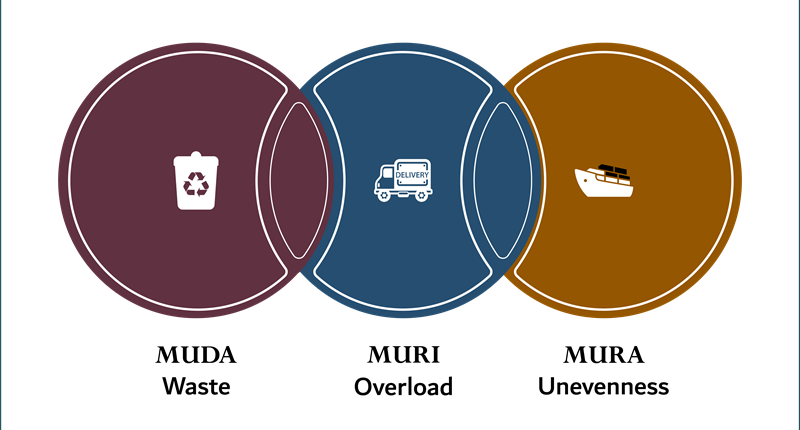
It’s Not All Muda (Waste); Don’t Overlook Mura (Unevenness)
Why Unevenness (Mura) Sinks Even the Best Canoers
2 min read

How do we create a workplace where people show up every day, ready to strive for higher organizational goals? It all comes down to translating “true north” (aka your organization’s guiding vision) into everyone’s daily work. The word “translation” is key. Every organization has language barriers, departmental silos, and communication gaps. These gaps often are the biggest obstacles, not the guiding vision itself.
When we talk about daily work, people focus on the shop floor. But change must start at the top.
Hajime Oba, my mentor, introduced me to “true north.” For him, true north meant the ideal state, the vision of what should be, not just what is. This is a radical shift. Most of us are engineers at heart, trained to deal with messy realities, not ideals. But as Oba insisted, true north defines what we should do, not just what we can do.
True north has two essential pillars:
In other words, we serve two groups: our customers, and our people. Both must thrive. That’s the foundation of translating our true north into our daily work.
GBMP’s tagline “Everybody, Everyday” captures this spirit. Every employee, every day, should focus on delivering value to the customer, within a secure yet challenging environment that inspires improvement.
Now, let’s get practical. I want to introduce two thinkers who shaped my approach: Shigeo Shingo and Ryuji Fukuda.
First, have you heard of Shingo’s “Seven Stages of Action”? His insight was simple: unless you complete all seven stages, nothing changes. This is the “law”—the hard truth.
Then there’s Fukuda’s X-Type Matrix, a strategic tool I introduced in my company back in 1989 to break the curse of siloed management. While Toyota doesn’t use this method, we found it powerful for aligning objectives and deploying strategy across functions. The X-Matrix wasn’t meant as a one-time fix; it’s an ongoing process, a living document that demands constant reflection and adjustment.
Let’s dig into Shingo’s Seven Stages:
So, here’s the hard truth: Many organizations falter in the middle. The vision is clear at the top, and the effort is real on the floor, but managers—the crucial link—often drift into old habits. The plan gets lost in translation, and momentum fades.
To succeed, you must bridge these gaps. Leadership must embody the vision: Managers must monitor, adjust, and sustain and teams must be empowered and aligned. This is how you turn true north from lofty philosophy into daily reality—and how great organizations achieve lasting transformation.
In summary: turning true north into daily work requires real executive commitment, clear priorities, cross-functional planning, and active management. Only then can we bridge the gap between ideals and reality—and achieve meaningful, lasting improvement.
The Bottom Line
Want to build an unstoppable culture? It starts at the top—but it lives on the floor.
You can make your True North a reality. You just have to do it Every. Single. Day.
 P.S. Years ago GBMP made an award-winning instructional video about this very topic. You can stream it here.
Why Unevenness (Mura) Sinks Even the Best Canoers

2 min read
When leaders talk about Lean, the conversation almost always centers on material flow. Reduce inventory. Improve throughput. Create continuous...